

The Neuroscience of Repeat Victimisation
One of the most heartbreaking questions I hear from survivors is:
"Why did this happen to me again?"
If you've ever asked yourself this question, I want you to hear something clearly before you read another word:
Abuse only happens because abusers choose to abuse.
No survivor causes sexual assault. No child invites grooming. No adult deserves coercion, manipulation or violence. The responsibility for abuse rests entirely with the perpetrator.
At the same time, decades of trauma research have shown that abuse can leave predictable changes in the brain and nervous system. These changes do not make someone responsible for future abuse—but they can make someone more vulnerable to being targeted by people who intentionally exploit vulnerability.
Understanding this isn't about blaming survivors.
It's about removing shame.
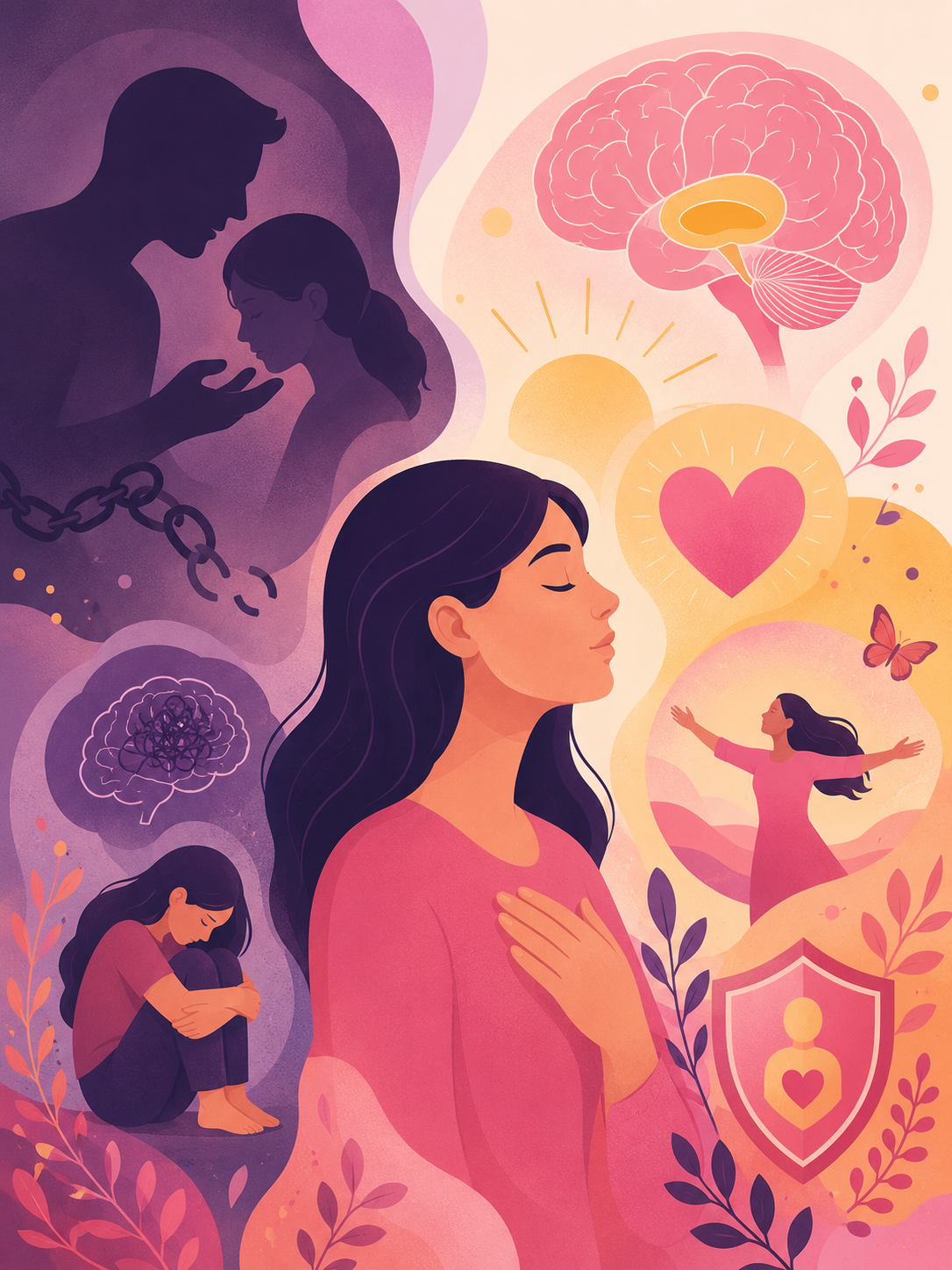
Trauma teaches survival-not safety
When children grow up experiencing sexual abuse, emotional abuse, neglect, coercive control or grooming, their nervous system adapts to survive.
Many survivors develop freeze or fawn responses.
Rather than fighting back or escaping, the brain learns that becoming still, compliant, pleasing others or reducing conflict is the safest way to stay alive.
These responses are incredibly intelligent survival adaptations.
Unfortunately, they can continue long after the danger has passed because the nervous system has learned that these responses kept it alive.
This is not weakness.
It is neurobiology.
Grooming changes boundaries
Grooming rarely begins with obvious abuse.
Instead, it often involves small, gradual violations of trust and boundaries.
A child may repeatedly learn:
My discomfort doesn't matter.
Saying "no" isn't safe.
Adults are allowed to cross my boundaries.
Other people's needs come before mine.
I should ignore my instincts.
Over months or years, these experiences reshape what feels "normal."
As adults, survivors may intellectually recognise healthy boundaries, yet their nervous system may not immediately identify subtle manipulation because those behaviours became familiar during development.
Healthy relationships can even feel unfamiliar at first because they don't match what the nervous system learned to expect.
Trauma changes the brain's threat detection system
One area of the brain increasingly recognised in trauma research is the insular cortex, often called the insula.
The insula acts like the brain's internal sensing system.
Every moment, it monitors information coming from inside your body, including:
Heart rate
Breathing
Muscle tension
Gut sensations
Internal bodily awareness (interoception)
It then combines those body signals with information from the outside world to help answer an important question:
"Am I safe?"
This is why people often describe danger as a "gut feeling."
Those sensations are not just emotional—they are neurobiological.
When the insula becomes dysregulated
Chronic trauma can alter how effectively the insula processes information.
For some survivors, the system becomes under-responsive.
The tightening in the stomach.
The increased heart rate.
The subtle sense that something feels "off."
These warning signals may not be consciously recognised until much later.
Other survivors experience the opposite.
Their nervous system becomes over-responsive, making neutral situations feel threatening and creating constant hypervigilance.
Neither response is a choice.
Neither reflects poor judgement.
Both are understandable adaptations to overwhelming experiences.
When the brain receives altered information from its internal warning system, recognising subtle manipulation or escalating boundary violations can become much more difficult.
What research tells us about perpetrators
Perhaps the most important part of this conversation is what research tells us about offenders.
Many perpetrators do not offend randomly.
They actively assess vulnerability.
Research has shown that many sexual offenders engage in boundary testing before committing abuse.
They may:
Ignore small expressions of discomfort.
Stand too close.
Ask increasingly personal questions.
Push boundaries gradually.
Observe how someone responds when they feel uncomfortable.
Continue despite subtle signs of hesitation.
If someone confidently enforces boundaries, perpetrators often move on.
If someone freezes, fawns, apologises, minimises their discomfort or doubts themselves, a perpetrator may interpret this as an opportunity to continue.
Notice where the responsibility lies.
The vulnerability was created by trauma.
The exploitation was chosen by the perpetrator.
Those are two completely different things.
The survivor did not create the abuse.
The perpetrator made that decision.
Every single time.
Healing is about restoring what trauma disrupted
The hopeful news is that the brain remains capable of change throughout life.
Trauma therapy doesn't erase the past.
It helps rebuild what trauma disrupted.
Evidence-informed therapies such as EMDR, somatic therapies and other trauma-focused approaches can help survivors:
Reconnect with their body's internal warning signals.
Strengthen healthy boundaries.
Trust their instincts again.
Recognise subtle manipulation earlier.
Feel safer in relationships.
Respond from the present instead of survival mode.
Healing isn't about becoming "less vulnerable" because the abuse was somehow your fault.
It is about giving your nervous system the opportunity to experience what safety was always meant to feel like.
The message every survivor deserves to hear
If you have experienced repeated victimisation, please know this:
You are not broken.
You are not attracting abuse.
You are not responsible for another person's decision to violate your boundaries.
Trauma leaves understandable footprints in the brain and nervous system.
Perpetrators deliberately exploit vulnerability.
Those two facts can exist together without placing an ounce of responsibility on survivors.
Because the truth remains unchanged:
Abuse only happens because abusers choose to abuse.